At times, do you feel like you’re dictated to by life? By friends, family, and society in general?
Expectations and responsibilities abound, and then one day, you find yourself unconsciously behaving a certain way just because of societal norms and trends imposed on you by the ubiquitous “they”.
Do you catch yourself doing what “they” say you should do, believing what “they” say is the most current research and reciting what “they” say is the absolute truth?
We often follow blindly, thinking we are current and informed, but time rarely allows for deeper inquiry.
So, when do we allow our unique individualism and creative perspectives to come into view?
With that in mind, one morning, as I got dressed for the gym, I gained a new awareness of some of my behaviour.
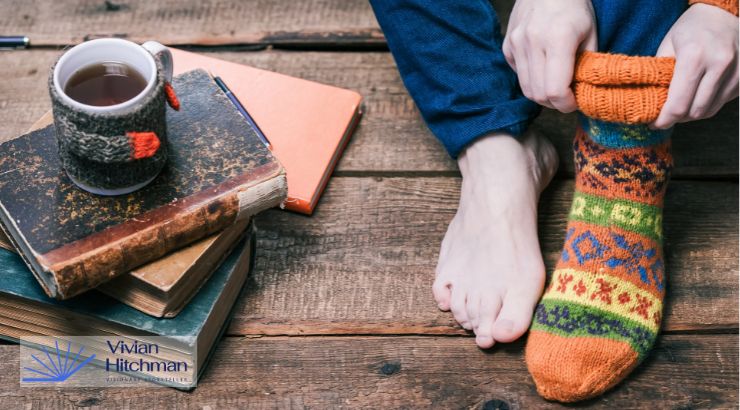
While this only seemed like a minor infringement on my free-thinking, I noticed that I regularly succumbed to the left/right sock habit, obeying the directive to pull the sock marked with L onto my left foot and the one marked with R onto my right foot.
But I must have put them on the “right” way umpteen times before I bothered to question why I’d even fallen into this preordained and repetitive behaviour.
Was switching socks to their respective feet really necessary and justified?
Companies would have us believe that this distinction is for improved fit, comfort, performance benefits, and durability. They claim that the left and right socks are stitched differently to support the unique curvature of our feet.
However, feet are structured differently, and there is no universally shaped foot.
For example, not all shoes fit me, and as a result, one of my least favourite tasks is shoe shopping, as I end up having to try on limitless pairs before finally finding one that actually fits comfortably.
They’re either too narrow in the toes, too loose in my heels, have an uncomfortable rise of the footbed, or have stitching in the wrong places.
So, I wonder, why have I fallen for the left/right sock habit?
Could it be a clever marketing ploy by sock manufacturers to give the impression of heightened quality and value?
Whatever the case, societal norms, work cultures, relationship expectations, and fashion trends seep into our lives gradually from our early years.
Toddlers respond to what feels comfortable, which sometimes means wearing their shoes on the opposite foot, but quickly fold into observance of others, mostly their parents.
They replicate what they see, hear, and experience from those around them.
The very young want to imitate their parents while teens live in defiance of them, as the desire for acceptance by peers unwittingly takes hold.
Teens want to fit in and belong to a group that defines their emerging identity.
In his book, The Tipping Point: How Little Things Can Make a Big Difference, Malcolm Gladwell refers to teens as being connectors of ideas which they spread through their network of friends.
Their easy access to cell phones enhances what Malcolm calls the “stickiness factor” so that when an idea takes hold, a trend is created.
And trends can spread amongst teens like wildfire.
Trends also tend to show up in family life, personal and professional relationships, and in societal norms and rules.
We perform behaviours over and over until they become habit and then we go into autopilot, like me putting the left sock on the left foot and the right sock on the right foot.
Green light means go and red light means stop are clearly necessary safety rules.
Dress codes are expected, opinions and thoughts are imposed, and discipline practices are rooted in past etiquette.
But regardless of what inspires these shifts in behaviour, they tend to happen quickly and unconsciously.
And only when we take notice of the subtle, everyday examples of how our behaviour is being dictated do we question this.
Habits come into question when they no longer have value, and are no longer practical or functional.
In any case, it’s often the young who will challenge outdated norms.
For instance, in the past, it was considered inappropriate for men to wear hats in restaurants or to the theatre. Only women could be adorned by voluminous headgear in these places.
But today, men’s baseball caps are frequently worn in most theatres and restaurants.
A habit can also serve us by routinizing our life, as it doesn’t rely on discipline or guilted behaviour.
Its neutral detachment allows us to perform from a place of autopilot, which lightens decision fatigue, conserving energy and time.
For example, making a habit of going to the gym at a predetermined time reduces any waffling on your decision of whether or not to go.
Nike’s apt slogan “Just Do It” encourages the former.
Having said that, here are some habits I make a point of adhering to:
- Even if you’re busy, eat healthily.
- Even if you’re tired, go for a walk.
- Even if you’re unmotivated, work out.
- Even if you’re in a bad mood, try to be positive.
Making these kinds of commitments can help you shift your mindset and create healthy habits that will change your life.
At any rate, habits give our brain a rest from deliberation, and while it can feel great to be on autopilot, it’s not always the best mode to be in.
When you’re driving on autopilot, for instance, especially along familiar and repetitive routes, your awareness can slip into a careless imprudence, causing you to narrowly miss an equally distracted pedestrian on an iPhone or a child or dog racing onto the road after a ball.
Depending on the context, operating on autopilot can be great, but if it causes you to pay less attention to the road than you should, then the results can be catastrophic.
And this brings me to the point of my article: How often are we distracted and forget to follow a rule that is in place for our safety?
Or how often is our behaviour distracted by the media’s clever marketing?
Whatever the case, having awareness of your behaviour is the first step in being able to question the choices you make and why you make them.
That being said, I think I’m going to create a habit of leaving that left sock on my right foot and the right sock on my left foot.
After all, some societal norms and rules are meant to be broken!